
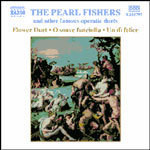
The Pearl Fishers and other famous operatic duets (Also includes the Flower Duet from Lakme)
 $30.00
Special Order
$30.00
Special Order3 - 6 weeks add to cart
The Pearl Fishers and other famous operatic duets (Also includes the Flower Duet from Lakme)
Janez Lotric, tenor / Igor Morozov, baritone / Adriana Kohutkova, soprano / Denisa Slepkovska, mezzo-soprano and other artists
[ Naxos / CD ]
Release Date: Monday 22 September 2003
This item is only available to us via Special Order. We should be able to get it to you in 3 - 6 weeks from when you order it.
"A generous, well selected collection of operatic highlights capably sung and excellently recorded"
(musicweb.uk.net)
"A generous, well selected collection of operatic highlights capably sung and excellently recorded ... A collection such as this is an impressive showcase of the Naxos operatic catalogue...these are all from recent Naxos recordings and all are at least very good. The music is well known, and this collection would be a good opera recording for a person with slight interest in opera, or just beginning a collection and wanting a good run through the highlights to serve until the complete operas could be obtained one by one. Throughout, the recording quality, orchestras, and conducting are first rate and often the equal of the finest orchestras in the world.
The real star of the collection is the opening number, the Pearl Fishers' duet. Not only one of the most substantial musically, it's very well sung and played, and is not heard nearly often enough.
Another high point for me is the Mimi of Luba Orgonasova, one of the great voices and great dramatic actresses of our time!Xalthough with a work played so often as Boheme, everyone will have a favourite recorded version chosen from among so many available. Miriam Gauci in the Manon Lescaut excerpt is also outstanding."
- Paul Shoemaker, musicweb.uk.net
The operatic duet, particularly in Italian repertoire of the nineteenth century, assumed great importance, often in an established, formal pattern. Here great emotions of love or anger, friendship or rivalry, could be given full expression. [1] The Pearl Fishers' Duet, from which the present collection takes its title, is from the 1863 opera Les pêcheurs de perles (The Pearl Fishers) by the French composer Georges Bizet. Set in Ceylon, the plot deals with the love of Zurga, leader of the fishermen, and of his friend Nadir, baritone and tenor respectively, for the beautiful Leïla, a priestess of Brahma. In the first act duet Au fond du temple saint (In the depths of the holy temple) the two men recall the beauty of the girl they had once seen and whose pursuit they had both sworn to abandon, to preserve their own friendship. Nadir and Leïla are reunited, but their love, forbidden by Leïla's vocation, is discovered and both are to be put to death, until Zurga decrees mercy. When the High Priest reveals Leïla's identity, Zurga is furious, but later engineers the lovers' escape.
Three duets are drawn from Giacomo Puccini's well known opera La Bohème (Bohemian Life), first staged in Turin in 1896. A group of impoverished young artists share a garret in the Latin Quarter of Paris. There, when the others have left to celebrate money one of them has earned, the poet Rodolfo meets the little seamstress Mimì, who comes to ask for a light for her candle. [2] The couple fall in love, expressed at its optimistic height in the duet O soave fanciulla (O sweet girl). Later the lovers part, their relationship contrasted with the stormy affair between the painter Marcello and his coquettish Musetta. [5] In their garret once more Rodolfo tells Marcello that he has seen Musetta riding in a carriage, In un coupé, and finely dressed, caring more for what money can buy her than for love. Marcello counters by telling Rodolfo that he has seen Mimì, riding in a carriage, dressed up like a queen. Both men are secretly still in love and treasure keepsakes from their mistresses. This, the fourth act, ends with the return of Mimì, now dying of consumption, and her death in Rodolfo's arms. The third act had suggested the possible outcome. Outside a tavern by a toll-gate entrance to Paris, Mimì has come to look for Rodolfo. [8] She greets Marcello, Speravo di trovarti qui (I hoped to find you here). He tells her how he earns money by painting, while Musetta teaches customers in the tavern to sing. He advises her not to think of Rodolfo, who has left her out of jealousy. In the following passage Rodolfo joins Marcello, while Mimì remains hidden, and explains that he had parted from her because of her increasing illness and his inability to provide for her.
For reasons quite unoperatic the Flower Duet from the opera Lakmé, by Léo Delibes, has won wide popularity. The opera, first staged in Paris in 1883, is exotic in its Indian setting. Lakmé, daughter of the Brahmin priest Nilakantha, falls in love with the English officer Gérald. Wounded, through the machinations of Nilakantha, Gérald is carried into the forest, to be tended by Lakmé. When she realises that he is torn by loyalty to his regiment, she poisons herself.
[3] In the first act duet Dôme épais, le jasmin (Thick canopy of jasmine) Lakmé and her slave Mallika sing as they prepare to bathe in the idyllic temple garden.
Giuseppe Verdi's La traviata, first mounted in Venice in 1853, centres on the love of Alfredo for the fashionable courtesan Violetta. The intervention of Alfredo's father persuades her to give her lover up, although she unselfishly refuses to reveal her reasons for this. The couple are only re-united when, misunderstandings over, Violetta is dying of consumption. [4] The duet Un dì felice (One happy day), in the first act, allows Alfredo to express his love, while Violetta urges him not to think of her, as she has only light-hearted friendship to offer him.
Puccini's opera of 1904, Madama Butterfly, contrasts the young girl of the title, in an exotic Japanese setting, with the unscrupulous American whom she marries, she in all seriousness, he without intending a permanent relationship. [6] The wedding has been disrupted by the anger of her uncle at the match with a foreigner, but when they are left alone at their new house above the port of Nagasaki it seems a time for love. In Viene la sera (The evening draws on) Butterfly and Pinkerton sing of their apparent happiness.
Gaetano Donizetti's opera L'elisir d'amore (The Elixir of Love) was first staged in Milan in 1832. The plot deals with the love of the naïve young peasant Nemorino for the farm-owner Adina, her flirtation with the recruiting sergeant Belcore, and the activities of the quack doctor Dulcamara, whose supposed elixir, aided by a legacy from the boy's uncle, makes Nemorino an attractive proposition. [7] Anxious to have a second dose of the elixir to secure the affections of Adina, Nemorino raises money by enlisting, for Venti scudi (Twenty scudi) in Belcore's regiment, assured by Belcore that this step will bring him honour, glory, and love. Adina eventually relents and accepts Nemorino, buying him out of the army.
Tosca, an opera of political duplicity and murder, completed by Puccini in 1900, implicates the famous singer of the title in her lover, the painter Cavaradossi's involvement with revolutionaries. The lascivious Chief of Police, Baron Scarpia, promises to release his prisoner Cavaradossi in return for Tosca's compliance with his wishes. She pretends to agree, secures a laissez-passer and murders Scarpia, only to find, in the end, that Scarpia has deceived her: the mock execution of her lover is carried out in earnest, and she leaps to her death from the battlements of the prison. [9] In the first act of the opera Tosca calls out to her lover, entering the church where he is painting, forcing the fugitive revolutionary Angelotti to hide. She is suspicious, having heard voices, but agrees that they should meet that evening at Cavaradossi's villa.
The elaborate plot of Verdi's 1862 opera La forza del destino (The Power of Fate) pits Don Alvaro against Don Carlo, the brother of his beloved Leonora, whose father he has killed. The two meet again, when Alvaro, unaware of Carlo's identity, saves his life, but their final fatal meeting takes place a few years later. Alvaro, now Father Raffaele in a remote monastery, is induced to fight a duel with Carlo, whom he kills, but not before Don Carlo has been able to kill his sister Leonora, who has been living as a hermit nearby. [10] In the duet Solenne in quest'ora (In this solemn hour), Alvaro, having saved Carlo's life, is wounded in battle and begs his new friend, whose identity he does not suspect, to burn documents he has, without reading them, in the event of his death.
Puccini's Manon Lescaut, first staged in Turin in 1893, takes the story of the heroine of the title, who elopes with the Chevalier Des Grieux, only to desert him for the rich old man Geronte, in accordance with her brother's earlier plans. Des Grieux, now enriched, returns to her life. She plans to leave Geronte, delaying to gather together the jewels he has bestowed on her, but is denounced by Geronte as an immoral woman, and sentenced to banishment. Des Grieux follows her to her exile in the American wilderness, where she dies in his arms. [11] In the duet O sarò la più bella (Oh, I shall be the most beautiful) Manon admires herself in the mirror, preparing to go out with Geronte. She is interrupted by Des Grieux, returning to her life, and asks if he can forgive her faithlessness. While she begs his forgiveness, their old love revives and she falls into his arms.
Verdi's Don Carlo had its first performance in a French version in Paris in 1867. The Spanish Infante Don Carlos is obliged to give up Elisabeth de Valois, whom he was to have married, in favour of his father, Philip II of Spain. Difficulties ensue, as Carlos still loves Elisabeth, while the Princess Eboli, who had hoped for his affections, is mortally jealous. Carlos, involved in attempts to free Flanders from his father's rule, is finally saved by the seeming intervention of the ghost of Charles the Fifth, in the person of an old monk, wearing the Emperor's crown and mantle, giving Carlos the final protection of the cloister. [12] In the second act Carlos, at the monastery of San Giusto, hears from his friend, the Marquis of Posa, of the battles in Flanders, admits his love for his father's wife and vows eternal friendship with Posa in Dio, che nell'alma infondere (God, who instils in the soul).
One of the most successful of all comic operas, Gioachino Rossini's Il barbiere di Siviglia (The Barber of Seville) had its first performance in Rome in 1816. The plot involves the deception of old Dr Bartolo, as the disguised Count Almaviva, helped by Figaro, the barber of the title, woos Bartolo's ward, Rosina, with final success. [13] In the first act duet All'idea di quel metallo (At the idea of that money) Figaro finds his imagination inspired by the promise of money from the Count. The latter should disguise himself as an officer, to be billeted on Dr Bartolo, and drunk into the bargain. This is the plan that they then put into action.
Verdi based three operas on Shakespeare, Macbeth, the final comedy Falstaff and the tragedy Otello. The successful general of the title, a Moor, married to the Venetian Desdemona, has his jealousy of his wife excited by Iago. [14] In Era la notte (It was night) Iago suggests proof of Desdemona's infidelity, telling how he heard Cassio, her supposed lover, murmuring in his sleep of his love for her. He goes on to adduce the evidence of the handkerchief, Othello's gift to his wife, seen in Cassio's possession. Convinced of his wife's guilt, Othello, in Sì, pel ciel marmoreo giuro! (I swear by marble heaven), swears an oath of vengeance, in which Iago joins.
- Keith Anderson
Tracks:
GEORGES BIZET
Les pecheurs de perles: Au fond du temple saint
01. Les pecheurs de perles - An fond du temple saint 05:50
Janez Lotric, tenor / Igor Morozov, baritone
Slovak Radio Symphony Orchestra (Bratislava)
Johannes Wildner, conductor
GIACOMO PUCCINI
La Boheme: O soava fanciulla
02. La Boheme - O soave fanciulla 03:38
Luba Orgonasova, soprano / Jonathan Welch, tenor
Slovak Philharmonic Chorus
Slovak Radio Symphony Orchestra (Bratislava)
Will Humburg, conductor
LEO DELIBES
Lakme: Dome epais, le jasmin (Flower Duet)
03. Lakme - Dome epais le jasmin 05:32
Adriana Kohutkova, soprano / Denisa Slepkovska, mezzo-soprano
Slovak Radio Symphony Orchestra (Bratislava)
Johannes Wildner, conductor
GIUSEPPE VERDI
La traviata: Un di felice
04. La traviata - Un di felice 03:03
Monika Krause / Yordy Ramiro, tenor
Slovak Philharmonic Chorus
Slovak Radio Symphony Orchestra (Bratislava)
Alexander Rahbari, conductor
GIACOMO PUCCINI
La Boheme: In un coupe
05. La Boheme - In un coupe 04:10
Fabio Previati, baritone / Jonathan Welch, tenor
Slovak Philharmonic Chorus
Slovak Radio Symphony Orchestra (Bratislava)
Will Humburg, conductor
Madama Butterfly: Viene la sera
06. Madama Butterfly - Viene la sera 04:19
Miriam Gauci, soprano / Yordy Ramiro, tenor
Slovak Philharmonic Chorus
Slovak Radio Symphony Orchestra (Bratislava)
Alexander Rahbari, conductor
GAETANO DONIZETTI
L' elisir d' amore: Venti scudi!
07. L' elisir d' amore - Venti scudi! 07:19
Giacomo Aragall, tenor / Eduard Tumagian, baritone
Slovak Radio Symphony Orchestra (Bratislava)
Alexander Rahbari, conductor
GIACOMO PUCCINI
La Boheme: Mimi! Speravo di trovarti qui
08. La Boheme - Mimi! Speravo di trovarti qui 04:46
Luba Orgonasova, soprano / Fabio Previati, baritone
Slovak Philharmonic Chorus
Slovak Radio Symphony Orchestra (Bratislava)
Will Humburg, conductor
Tosca: Mario! Mario! Mario!
09. Tosca - Mario! Mario! Mario! 03:20
Giorgio Lamberti, tenor / Nelly Miricioiu, soprano
Slovak Philharmonic Chorus
Slovak Radio Symphony Orchestra (Bratislava)
Alexander Rahbari, conductor
GIUSEPPE VERDI
La forza del destino: Solenne in quest'ora
10. La forza del destino - Solenne in quest'ora 03:29
Giacomo Aragall, tenor / Eduard Tumagian, baritone
Slovak Radio Symphony Orchestra (Bratislava)
Alexander Rahbari, conductor
GIACOMO PUCCINI
Manon Lescaut: O saro la piu bella!
11. Manon Lescaut - O sara la piu bella! 09:15
Miriam Gauci, soprano / Kaludi Kaludov, tenor
BRT Philharmonic Chorus / Jaak Gregoor Choir
Belgian Radio and Television Philharmonic Orchestra
Alexander Rahbari, conductor
GIUSEPPE VERDI
Don Carlo: E lui...Dio che nell'alma infondere
12. Don Carlo - E lui ... Dio che nell'alma 07:24
Giacomo Aragall, tenor / Eduard Tumagian, baritone
Slovak Radio Symphony Orchestra (Bratislava)
Alexander Rahbari, conductor
GIOACHINO ROSSINI
Il barbiere di Siviglia: All'idea di quel metallo
13. Il barbiere di Siviglia - All'idea di quel metall 08:33
Roberto Servile, baritone / Ramon Vargas, tenor
Hungarian Radio Chorus
Failoni Chamber Orchestra, Budapest
Will Humburg, conductor
GIUSEPPE VERDI
Otello: Era la notte...Si, pel ciel marmoreo
14. Otello - Era la notte...Si, pel ciel marmoreo giuro 06:43
Janez Lotric, tenor / Igor Morozov, baritone
Slovak Radio Symphony Orchestra (Bratislava)
Johannes Wildner, conductor
