
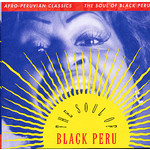
Afro-Peruvian Classics: The Soul of Black Peru
 $40.00
Out of Stock
$40.00
Out of Stock6+ weeks add to cart
Various Artists
Afro-Peruvian Classics: The Soul of Black Peru
[ Luaka Bop / LP ]
Release Date: Friday 18 April 2014
This item is currently out of stock. It may take 6 or more weeks to obtain from when you place your order as this is a specialist product.
This is secret music - a collection of beautiful songs and infectious grooves that's been hidden for years in the coastal towns and barrios of Peru. It's not the guys with flutes and drums in woolly hats - it's music of the black Peruvian communities. Black Peruvians? Yes, Peru was involved in the slave trade too - and this wonderful, funky music is part of that legacy.
This music survived (barely) within the black communities, and was not accepted outside of those communities until the spark of black pride, ignited in the 1960s, caught fire in the '70s and '80s. Now, in the '90s, this music is the pride of Peru - cassettes of it are sold on the street alongside techno, Megadeth and Andean folk groups. And while it maintains its funky roots, it has attracted the creative talents of the best contemporary musicians, writers and poets who have furthered the evolution, growth and spread of this music. It's not a secret anymore - and it's yours to dance to.
Some Notes on the Songs:
Casa Blanca, Matalapo, Villarona, Acari, Cutucan, San Luis, San Regis, El Carmen, El Guayabo and Cañeñe, all mentioned in the lyrics, are black Peruvian communities.
The three main dances in Afro-Peruvian circles are the Landó, Samba Malato and the Alcatraz. Toro Mata, Son de los Diablos, and Zamacueca are also dances.
A Zig Zag History
Though the story of Afro-Peruvian music is an ancient one, it has become widely known only recently. Centuries old, this music started to gain recognition in Peru 40 years ago and became popularized only in the last 25 years. It was born in the coastal barrios and towns and was reconstructed and resurrected thanks to the work of a few artists and historians. Perhaps, since so much seems upside-down or backwards in this story, we ought to begin at the end.
Nowadays, it isn't unusual to go to a party or a music bar in Peru and, after an hour or two of the latest American pop hits or the newest salsa records, hear the unmistakable sounds of Afro-Peruvian music-both old and new simultaneously. Not only does it fuse well with the imported sounds which are so popular in Peru today, but it has become an inseparable part of the current music scene. Whether they are found in jazz, reggae, rock or in ballads, the instruments-and most of all, the rhythms of Afro-Peruvian music-are basic and now essential ingredients in contemporary Peruvian popular music.
This is the happy ending to a long story that begins tragically with the forced movement of slaves that ended within South America. The beginnings of slavery in 15th century Peru were different from the rest of the Americas. Although in Brazil or Central and North American countries it was common to import large groups of slaves from the same African tribe, only small and geographically dispersed ethnic groups were brought to Peru. This was meant to discourage rebel movements around tribal chiefs, and as such, made almost impossible the preservation of communal traditions. Without a common language or tribal authority to remind them of their roots, Peruvian slaves were progressively integrated into the culture and language of their new country.
As a result, Afro-Peruvian music is a unique blend of Spanish, Andean and African traditions. The language comes from Spain, as does the preference for poetic forms like the décima and the copla, and the guitar as a musical instrument. From the Andes come the pantheistic religiosity common to both African and Andean cultures, and the melancholy of certain musical forms like the Yaravi, and the Hatajo de Negritos or the Danza de Pallas. And from Africa come the visceral and seductive rhythms, passed down from generation to generation through dance.
And dance is what really gives meaning to this music. You can feel it the first time you hear it. Afro-Peruvians dance during thier suffering or their joy, at parties or funerals, at work or rest. In this culture, the body asks for free and ample expression, without judgment. One reason why this ancient tradition remained so marginalized, first in the living quarters of slaves and later in the black urban neighborhoods, was precisely because free bodily expression-sensuous, erotic and festive-was too explicit for more conservative social groups. Words like 'indecent,' 'immoral' and 'obscene' were used to describe these dances. Only a few, such as the marinera and tondero, were ever accepted into the official folklore.
It is not coincidental that this rebirth of Afro-Peruvian music took place in the late sixties and early seventies. The sexual liberation and international black pride movements were factors, as was the political atmosphere of the moment. The first years of a leftist military dictatorship in Peru favored nationalistic expressions, which helped to popularize and push to the fore the long hidden work of many artists and musicians.
It was probably the appearance of a musical group called Peru Negro which rescued black music and dance from obscurity and finally gave name and form to something that, until that time, seemed fragmented and elusive. Until the early seventies practically no one, outside of specialized circles, talked about "Afro-Peruvian music" as such. "Toro Mata," a theme included in Peru Negro's first record and danced in their show, was an absolute success and was even sung by the Queen of Salsa, Celia Cruz. The attractive choreography of Victoria Santa Cruz had a strong impact on a country in search of its cultural identity. People were conscious of the need for change in their impoverished country. Beginning again requires self-knowledge and self-pride, and in that sense, this music was a revelation for a part of society that had been marginalized. The Afro-Peruvian fever was contagious. Soon everybody danced, imitating Peru Negro.
Finally, no discussion of Afro-Peruvian music would be complete without reference to its unique instrumentation. One rarely sees more humble musical instruments used more effectively. Besides the guitar (the only instrument inherited from their old masters) the most important instrument is the cajón, a simple wooden box upon which the player sits and plays with his hands between his legs. But you can't use just any wooden box. Nowadays the cajón is built by instrument makers, and even if it is not as sophisticated as a guitar or violin, it must be built under specific conditions which foster its rich resonance. There are no schools that teach cajón and there is no way to grasp its interpretation from musical scores. Unknown outside Peru some years ago, it is not unusual to find it today in some Brazilian, Cuban or even Spanish flamenco groups. The famous Spanish flamenco guitarist and composer, Paco de Lucía, has incorporated the cajón in his ensemble for the past ten years. Other Afro-Peruvian instruments include the quijada de burro (a jaw bone of a burro, with loosened teeth which vibrate when struck), and the cajita (a little wooden box with a top that is opened and shut in rhythmic time).
The selection of music included in this recording is a perfect introduction to the variety of Afro-Peruvian rhythms and forms. Songs like Samba Malató, Toro Mata, and Son de los Diablos belong to the most ancient forms of music and dance born in the 17th and 18th centuries, like the Landó, Festejo, Alcatraz or Ingá. Nevertheless, some of them have become modernized. It is interesting to compare the Landó sung by Lucila Campos, for example, with the one by Chabuca Granda. The former is related to the deepest, most primal needs of joy and sensuality, while the second is a sweet, melodic contemporary piece. The songs interpreted by the younger generation in this selection - Cecilia Barraza and Susana Baca - are related to their ancestors too, but only as the foundation for each artists' original work.
Today, the black population in Peru is not very large, even if the country's "melting pot" makes it difficult to speak about race. Black music and dance traditions have kept their original forms in some towns south of Lima, such as Chincha and Cañete. But history here is everything but pure. Afro-Peruvian music is still developing. It doesn't sound like any of its Caribbean or Brazilian relatives. It sounds different; it moves the dancers in a different way. And if it sounds like this history goes backward and forward, from one side to the other, it may be because its movement is restless and doesn't want to be reigned in. This music is an invitation to life and to the mysteries of its creation.
- Fietta Jarque
Some Notes On The Artists
The present popularity of Afro-Peruvian music owes its beginnings to the artists and ethnomusicologists who breathed new life into a tradition which, for generations, lay dormant. One of the undisputed pillars of the Afro-Peruvian musical resurgence was poet, composer, and musicologist Nicómedes Santa Cruz. In the 1950s, he began compiling and rejuvenating Afro-Peruvian cultural forms; later, as a student and supporter of the black consciousness movement, he used radio and television as forums for bringing many unknown Afro-Peruvian musicians to public attention.
Artist and folklorist Abelardo Vásquez was formerly Senior Professor at the Peruvian Center of Black Folklore. A well-respected folk musician in his own right, Abelardo Vásquez performs regularly at his own Afro-Peruvian after-hours club (or peña)-along with many members of his family.
If others helped resuscitate Afro-Peruvian music, then Peru Negro brought this movement to its feet. Though best known for igniting the Afro-Peruvian dance craze during the politically charged 1970s, Peru Negro also has a reputation for rigorous authenticity in their reconstruction of traditional dances and songs. Originally from El Carmen in the Peruvian countryside, director Reynaldo Campos and his family have performed in many countries, representing not only Afro-Peruvian folklore but all of Peruvian popular culture.
The remaining artists featured in this compilation are the heirs of the traditionalists' legacy. Some popularized traditional Afro-Peruvian music by incorporating it into their existing repertoires; others are expanding on the tradition, adding their own idiosyncratic and contemporary twists.
Lucila Campos, an extremely popular club singer with many successful recordings, developed a salsa vocal style distinguished by short vocal improvisations and impromptu dialogue with both her band and her audience.
Manuel Donayre is a newcomer to the field who began as a singer of boleros, but ultimately became a successful exponent of the music of his ancestors. His original songs (such as "Yo No Soy Jaqui"), affirm his own cultural identity, and follow the style of traditional black songs. Known for his distinctive, high voice, Manuel Donayre might be considered the Jimmy Scott of Peru.
Cecilia Barraza, a well-known singer of the criolle waltz that has been fashionable since the beginning of the century in urban Peru, is distinguished from other Creole singers by her style of combining traditional Afro-Peruvian music with popular songs. She performs in Lima, her home city, as well as in Mexico.
Chabuca Granda had a long career as a composer and art-pop singer before discovering Afro-Peruvian music. In fact, she did not begin composing Landós until well into her seventies! Her innovations include adding horns and strings to the traditional instrumentation and, with Nicómedes Santa Cruz, elevated the lyrical content of Afro-Peruvian music to a new level, which set new standards now maintained by other writers. She wrote four of the songs on this compilation ("Maria Lando" and "Canterurias," as well as the two she sings).
Eva Ayllón, hardly recognized for her work in the '70s is now one of the most popular and celebrated Afro-Peruvian singers. Known as "the golden voice of Peru," she is credited with contemporizing Afro-Peruvian music and bringing these ancient rural musical forms to the great classical auditoriums. Not strictly a singer of black music, she is also popular as a singer of Creole themes.
We think it's only fitting to end our story with Susana Baca, who truly was the inspiration for this album. Her soulful rendition of Maria Lando captivated us and convinced us to explore more of this music. We found, surprisingly, that though her voice is stunning and she is a very respected singer, she has never had a record released on a commercial label in Peru. A dedicated student of traditional Afro-Peruvian forms-much like the first generation of Afro-Peruvian musicians and ethnomusicologists-Susana nevertheless represents the new generation of singers and composers of the more "sophisticated" Afro-Peruvian music.
Tracks:
Side A
1. Maria Lando - Susana Baca
2. Yo No Soy Jaqui (I Am Not Jaqui) - Manuel Donayre
3. Canterurias - Cecilia Barraza
4. Samba Malato - Lucila Campos
5. Enciendete Candela (Light The Flame) - Roberto Rivas & El Conjunto Gente Morena
6. Azuca De Cana (Sugarcane) - Eva Ayllon
7. Prendeme La Vela (Light My Candle) - Abelardo Vasquez & Cumanana
Side B
1. Lando - Chabuca Granda
2. Toro Mata (Bull Kills) - Lucila Campos
3. Son De Los Diablos (Dance Of The Devils) - Peru Negro
4. No Me Cumben (That's Not For Me) - Nicomedes Santa Cruz
5. Una Larga Noche (A Long Night) - Chabuca Granda
6. Lando - Peru Negro
7. Maria Lando - David Byrne
8. Zapateo En Menor - Vincente Vasquez D.
