
Double Choir Masses
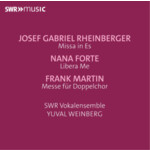 $35.00
Pre-order now
$35.00
Pre-order nowAvailable: Jun 12 add to cart
JOSEF GABRIEL RHEINBERGER / FRANK MARTIN
Double Choir Masses
SWR Vokalensemble, Yuval Weinberg (conductor)
[ SWR / CD ]
Release Date: Friday 12 June 2026
Pre-order your copy NOW!
Rheinberger composed his Cantus Missae in 1878, during his tenure as director of chapel music at the court of King Ludwig II. The work embodies a successful reconciliation of the conflicting artistic currents of his time, and it is precisely this perfect equilibrium that has rendered it timeless. The Mass captivates with its melodic, often almost Lied-like character; yet, on closer listening, the music reveals a striking modernity for its era.
Nana Forte's Libera me was written almost 150 years after the Cantus Missae. It is a spiritual drama in which the composer draws on the traditional techniques of writing for doublechoir, letting the choirs interlock contrapuntally or overlap in contrasting layers, as in the passage tremens factus sum ego (trembling has overtaken me).
Frank Martin kept the manuscript of his Mass for Double Choir in a drawer for nearly forty years, regarding it as something solely between himself and God. In sound and musical language, the Mass is unmistakably a work of the twentieth century, yet one hears echoes of Gregorian chant and senses that the composer consciously places himself within the centuries-old tradition of double-choir composition and the symbolic world of Mass settings. Martin's work is shaped by the tension between tradition and modernity, personal confession and doctrinal expectation; but rather than seeking a 'golden mean', he approaches these themes both as a seeker and a questioner. The result is one of the most highly regarded Mass settings of the twentieth century.
Tracks:
JOSEF GABRIEL RHEINBERGER (1839 -1901)
Cantus Missae, Messe in Es op. 109
1. I Kyrie
2. II Gloria
3. III Credo
4. IV Sanctus
5. V Benedictus
6. VI Agnus Dei
NANA FORTE (*1981)
7. Libera me
für 2 gemischte Chöre a cappella
FRANK MARTIN (1890 -1974)
Messe für Doppelchor a cappella
8. I Kyrie
9. II Gloria
10. III Credo
11. IV Sanctus
12. V Agnus Dei
