
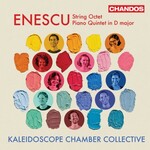
Enescu: String Octet, Piano Quintet
 $40.00
Special Order
3 - 6 weeks add to cart
GEROGE ENESCU
Enescu: String Octet, Piano Quintet
Kaleidoscope Chamber Collective
[ Chandos / CD ]
Release Date: Friday 11 September 2026
This item is only available to us via Special Order. We should be able to get it to you in 3 - 6 weeks from when you order it.
The Romanian composer George Enescu was a child prodigy and in October 1888, aged seven, become the youngest student ever admitted to the Vienna Conservatory (and the first non-Austrian), from which he graduated at the age of twelve. In addition to his career as a composer, Enescu was also an acclaimed conductor and violinist. He made his American début in 1923 conducting the Philadelphia Orchestra, and frequently conducted both the New York Philharmonic and the Orchestre symphonique de Paris. Enescu made numerous recordings as a violinist, of his own works and those of others: his 1949 recording of Bach's Sonatas and Partitas was very highly regarded, and as a teacher (at the Mannes School of Music, in New York) his students included Yehudi Menuhin, Christian Ferras, Ivry Gitlis, Arthur Grumiaux, and Ida Haendel, among many others). Enescu composed his Octet for Strings at the age of nineteen, taking a year and a half to complete it, owing to the complexity of the string writing. The first performance was cancelled when, after five rehearsals, the impresario Édouard Colonne removed it from the programme as 'too risky'. The performers have chosen to complete the album with the early Piano Quintet, which Enescu composed some four years before the Octet, during his time at the Paris Conservatoire. The work shows his reverence for his hero Brahms throughout, but also demonstrates his extraordinary command of form and texture at such an early age.
"No question about it, Enescu's String Octet is having something of a moment. There have been impressive recent recordings from the combined Ébène and Belcea Quartets (Erato, 3/26) as well as Vilde Frang and friends (Warner, 10/18) but it's a special pleasure to see the Kaleidoscope Chamber Collective turning to this fin de siècle mini-epic and rediscovering it as a chamber work in the truest sense.
True, Enescu sanctioned performances of the Octet by a string orchestra, but he stipulated that the quieter moments should still be played on solo strings. Despite its monumental scale, intimacy is a vital strand of the Octet's personality, and that's where Kaleidoscope score over their rivals. Even at its most intense (and these players don't lack power), this performance always sounds like eight individual musicians in passionate and articulate conversation, each contributing something to the texture. Chandos's recorded sound initially struck me as a little plain; but no, on repeated listening it proves exactly as lucid as it needs to be. Moments of extreme delicacy (such as the first violin's pianissimo reminiscences at the end of the first movement) are as potent as the most forceful triple fortes." Gramophone Bookmark recording Oct 26
Tracks:
Octet for strings in C major, op.7
Piano Quintet in D major
