
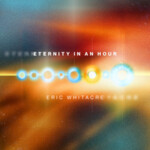
Whitacre: Eternity in an Hour
 $45.00
Out of Stock
$45.00
Out of Stockadd to cart
ERIC WHITACRE
Whitacre: Eternity in an Hour
Eric Whitacre (piano / synthesisers / electronics), Eric Whitacre Singers (choir), Emma Denton (cello), Jess Gillam (saxophone)
[ Decca / 2 CD ]
Release Date: Friday 16 October 2026
This item is currently unavailable via the quick and easy sources, but we’ll make enquiries for you. Please note - listed price is indicative only.
The new album by Grammy Award-winning composer and conductor Eric Whitacre is a deeply meditative hour-long work for choir, cello, piano and live electronics, it is one of Whitacre's most ambitious projects to date and the first of his classical compositions to place synthesisers at its centre. Recorded with the Eric Whitacre Singers, the album brings together his lifelong fascination with electronic sound and the choral writing for which he is renowned. Unfolding across eight uninterrupted movements, Eternity in an Hour explores ideas of presence, wonder and the slowing of time. Commissioned by BBC Radio 3 to mark the centenary of the BBC Singers, the work received its world premiere at the BBC Proms at the Royal Albert Hall in 2024, with Whitacre conducting and performing the electronics live on stage.
The 2-CD edition also include Auguries of Innocence, a companion collection of reworkings featuring saxophonist Jess Gillam on two tracks, alongside contributions from some of Whitacre's favourite ambient artists: BlankFor.ms, Lesjamusic, IDRA, Matt Lowery, Elin Piel and Luca Longobardi.
The hour-long work sets the opening lines of William Blake's Auguries of Innocence, expanding four short lines of poetry across eight uninterrupted movements:
To see a World in a Grain of Sand
And a Heaven in a Wild Flower,
Hold Infinity in the palm of your hand
And Eternity in an hour.
- from Auguries of Innocence by William Blake, 1757 to 1827
"I decided to take those four lines and see if I could create an hour-long piece that was a journey deeper and deeper into that grain of sand," says Whitacre. "Even in the simple there is perfection."
Whitacre first encountered the poem as a teenager and was struck by its parallels with Zen Buddhist philosophy. For him, Blake captures "that elusive state where past and future cease to exist and all that remains is a profound sense of wonder in even the most ordinary objects." Reflecting on the pace of modern life, he says: "These days every moment seem to be chopped up into oblivion; all of reality is like TikTok. My idea was to make an hour's worth of music setting just those four opening lines, to do exactly what Blake compels us to do and find 'Eternity in an Hour.'" Each movement introduces another fragment of the poem until all four lines are heard in full in the finale.
At the heart of this process is granular synthesis. Working with electronic artist Nick Lisher, known as Lesjamusic, Whitacre breaks the captured sounds into thousands of tiny fragments, or "grains", which are then stretched, layered and transformed. In live performance, the musicians listen to the electronics at certain points and respond to them, creating an evolving soundscape in which no two performances are alike. For Whitacre, the technique creates a direct link with Blake's "grain of sand", bringing the poem's imagery into the music itself. Whitacre notes: "Every single gesture has to be connected to the larger philosophy and structure". Through this layered symbolism and meditative approach to sound, he invites listeners to recognise what he describes as "exquisite beauty in a single, simple musical gesture."
"My hope with Eternity in an Hour is that the music will help the listener (and the performers and, candidly, me) experience a little bit of that awe and timelessness."
The album marks both a personal and musical shift for Whitacre. Best known for meticulously constructed a cappella works such as Sleep, Lux Aurumque and Cloudburst, he describes Eternity in an Hour as a culmination of his life as a musician. Long before he could read music, he was a self-confessed "synth nerd" who dreamed of joining Depeche Mode, and that fascination has remained with him ever since. On the recording, he combines the raw, mystical sound of the Lyra 8 synthesiser with a Tascam 424 tape recorder, while performing all the piano parts on his grandmother's 125-year-old piano, a sound deeply connected to his childhood.
"With this piece I'm actively trying to let go," Whitacre says. "On a very personal level, it's a path to letting go, to being present, to finding a universe in a grain of sand."
Whitacre also points to the influence of composer Steve Reich and ambient music pioneer Brian Eno, particularly in the way they create patterns and expectations before quietly changing direction. "When you surrender that sense of expectation," he says, "you find yourself in the moment, floating on those waves of sound."
Since its world premiere, Eternity in an Hour has been performed internationally, including its Australian premiere with Sydney Philharmonia Choirs at Sydney Opera House. Limelight awarded the performance five stars and described Whitacre as a "groundbreaker".
Tracks:
Auguries of Innocence
Eternity in an Hour
